
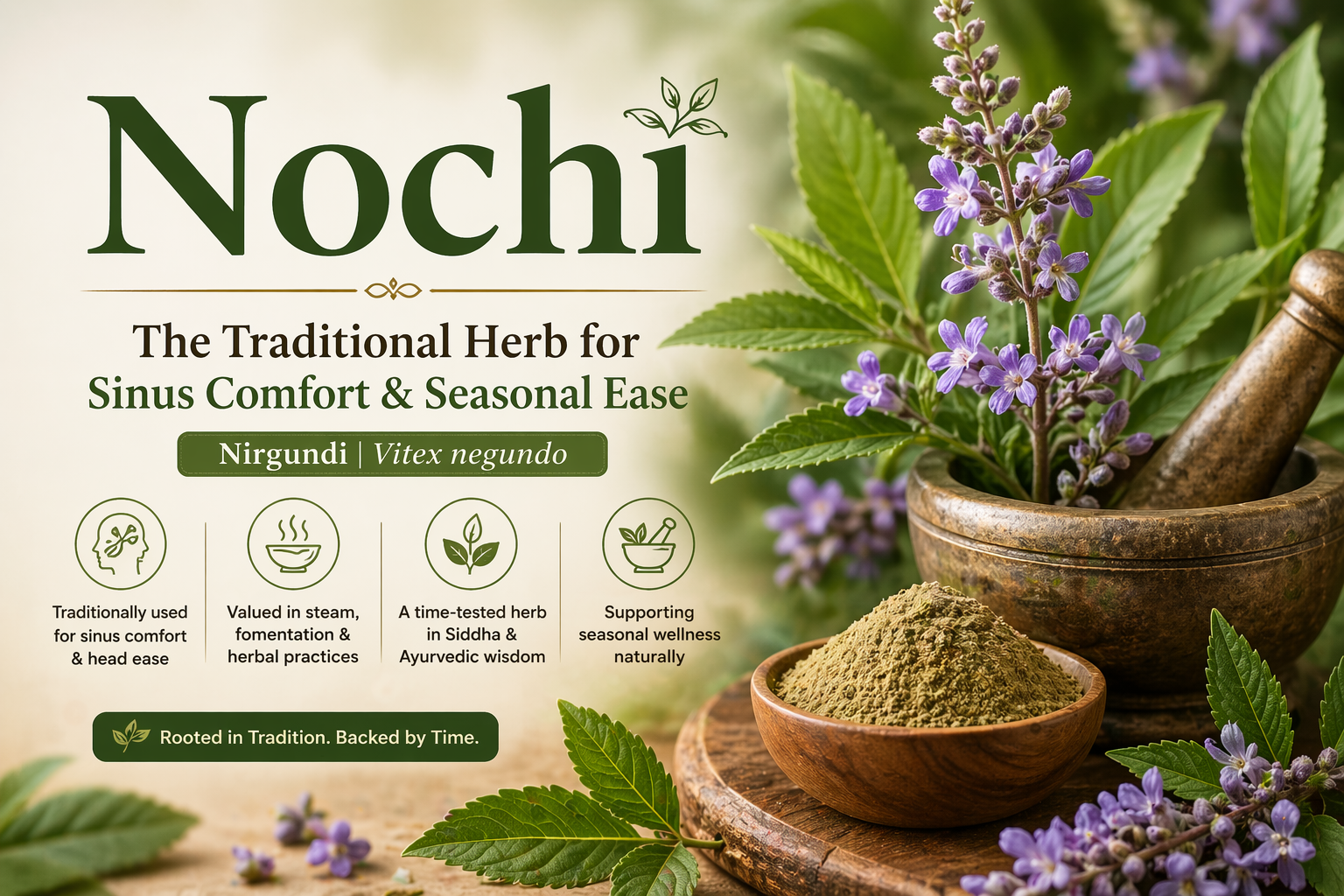
Botanical Profile
Nochi: The Traditional Herb for Sinus Comfort, Clearer Breathing and Seasonal Ease
Some herbs stay in traditional use because they are rare. Others remain because they are genuinely useful in everyday life. Nochi, also known as Nirgundi, belongs firmly to the second category.
This is the kind of herb that has long lived close to the household. In traditional Siddha and Ayurvedic practice, Nochi has been valued not only as a respected medicinal plant, but as a practical herb people turned to during periods of sinus heaviness, head discomfort, body aches, changing weather, and seasonal unease. Its reputation comes from lived use, not novelty.
A Herb with Deep Traditional Relevance
Nochi is widely known across India under different regional names and has a long-standing place in traditional herbal systems. The plant is recognized as an erect shrub with distinctive compound leaves and light purple flowers, and it has been used in various traditional routines for comfort and support.
What makes Nochi especially interesting is that it was not traditionally valued only in one narrow way. It appears in different forms of household and herbal practice, from steam inhalation to warming leaf applications, from fumigation to decoction-style use, which suggests a herb that people found broadly useful in day-to-day life.
Why Nochi is Often Linked with Sinus and Head Comfort
Among its best-known traditional uses, Nochi is closely associated with sinus support and head clarity.
In older household practice, Nochi leaves were commonly used in two especially memorable ways: Nochi steam and the Nochi pillow. These methods were valued in traditional use for people who felt heaviness in the head, sinus discomfort, or a sense of congestion that made the head feel dull and burdened.
That connection gives Nochi a very distinctive character. Some herbs are associated with digestion. Some with skin. Some with general wellness. Nochi has long been remembered as a herb of air, head, and relief.
A Traditional Herb for Body Ease
Nochi has also been traditionally associated with body comfort, especially where there is a sense of heaviness, stiffness, or physical unease due to weather changes.
Traditional use describes warmed bundles or poultices of Nochi leaves being applied externally over affected areas. This tells us something important about how the herb was understood: not merely as an internal botanical, but as a practical support herb used in direct, physical ways.
That gives the herb a grounded, real-world quality. It is not abstract. It is a herb people reached for when they wanted to do something simple and immediate within a traditional framework.
Traditional Uses That Make Nochi Memorable
One of the reasons Nochi remains so interesting is the variety of ways it has been traditionally prepared and applied:
1. Nochi Steam (Inhalation)
Traditional Nochi steam involves boiling Nochi leaves or powder in water and inhaling the aromatic vapors, often as part of a warming household routine intended for sinus heaviness and head discomfort.
2. Nochi Pillow
A traditional Nochi pillow is made by warming dried leaves and placing them inside a fabric cover, then resting the head on it for comfort against heaviness. This is one of the most distinctive household customs associated with the plant.
3. Nochi Kashayam (Decoction)
Traditional practice also utilizes a decoction-style preparation made with Nochi leaf powder and black pepper. While older descriptions often attach broad claims to such formulas, the grounded value today is in recognizing this as part of traditional seasonal herbal practice.
4. Nochi Fumigation
Traditional fumigation with Nochi leaf powder is another fascinating use. It reflects an older household wellness culture in which aromatic herbs were used not only topically, but also to refresh and clear the living environment.
More Than Just an “Herbal Remedy”
What makes Nochi appealing even today is that it represents a broader way of thinking about wellness.
It belongs to a time when herbs were integrated into routines, spaces, seasons, and lived domestic knowledge. The herb was not simply consumed; it was steamed, warmed, applied, smelled, and used around the home. That makes Nochi feel richer and more culturally alive than many modern botanicals reduced to one-line claims.
Why Nochi Still Deserves Attention Today
Modern life creates many familiar discomforts: changing weather, dust exposure, fatigue, long workdays, and the feeling of heaviness that can build in the head and body. In that context, traditional herbs like Nochi continue to attract interest because they offer an older, steadier approach to comfort.
Nochi may especially appeal to people who:
- value traditional Siddha and Ayurvedic herbs
- want to explore botanicals associated with sinus and head comfort
- appreciate household herbal practices like steam and aromatic care
- prefer herbs with a strong cultural and practical identity
YOGIS HERBS Nochi
At YOGIS HERBS, traditional herbs deserve to be presented with care, clarity, and respect. Nochi is one of those herbs whose value is not in flashy marketing claims, but in the depth of its traditional relevance.
For those exploring herbs rooted in seasonal support, sinus comfort, traditional household use, and classic botanical wisdom, Nochi remains a meaningful herb to rediscover.
Explore Pure Nochi Powder
Processed under GMP-certified conditions in Pollachi, Tamil Nadu. Fresh, pure, and traditionally prepared for your home wellness routines.
Shop Nochi Powder Browse all herbsFinal Thought
Some herbs survive because they are marketed well.
Nochi survives because people kept using it.
That is what gives it weight. It is not a trend herb. It is a traditional herb with memory, character, and practical identity. For anyone interested in the older ways herbs supported everyday comfort, Nochi is one of the most interesting places to begin.
Very very useful information.
Thanks for information…
But Is it really work? Any one who had cure sinus problem …please drop comment…
I am also suffering from sinus…
Very very useful for me